China has become a major source of Fitness Equipment for gyms, hotels, schools, and home users. Its manufacturers offer everything from treadmills and exercise bikes to strength machines and free weights. Yet a large factory does not automatically mean a better supplier. Product consistency, safety testing, communication, and after-sales support matter just as much.
This guide looks at leading Chinese manufacturers through practical buying criteria, not promotional claims. It considers product range, manufacturing experience, quality controls, customization options, and export support. Buyers should also examine details that can be easy to overlook: frame thickness, weld finish, display readability, spare-part availability, and warranty terms. Small details count.
There is no single best choice for every project. A hotel may need quiet cardio machines and straightforward maintenance, while a commercial gym may prioritize durable racks and a broad strength range. Price matters, but so does the cost of downtime. Ask for current specifications, test reports, and clear answers about service before placing an order.
Some information can change quickly. Product lines, certifications, and production capacity may differ by model or over time. So verify important claims directly with the manufacturer. This overview offers a starting point, not a substitute for due diligence. A polished catalog helps. A real conversation often reveals more.
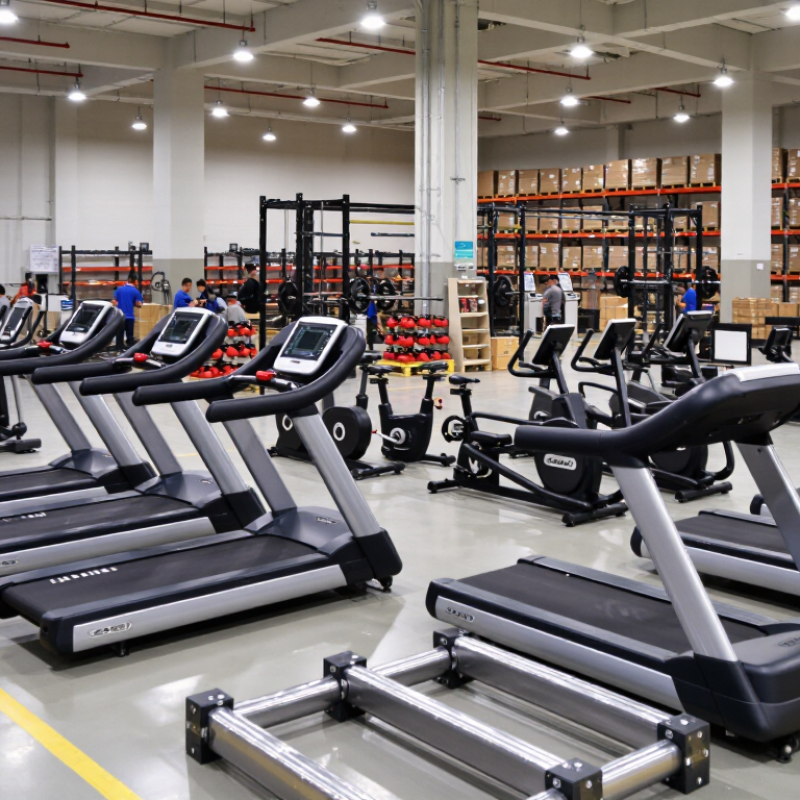
China’s fitness equipment industry combines metalworking, plastics, electronics, and assembly within broad manufacturing networks. Production is concentrated in several coastal provinces, where suppliers can source steel tubing, molded parts, motors, and packaging close to assembly facilities. This proximity can shorten lead times, though schedules still depend on component availability and shipping capacity.
The product range spans simple benches and weight racks to treadmills, exercise bikes, and connected training systems. On a factory floor, buyers may see cut steel sections, fresh welds, powder-coated frames, and equipment undergoing load or function checks. Details matter. A useful supplier assessment looks beyond catalog photos: ask how welds are inspected, how moving parts are tested, and whether production samples match the approved design. Testing methods vary, so comparisons need clear criteria. Not always.
Export experience has helped many manufacturers adapt packaging and documentation for overseas orders, but customization can add cost and delay. Smaller changes, such as display languages or frame colors, may be manageable; new software or tooling deserves closer review. One weakness is uneven public information about testing and quality procedures. That gap remains. Buyers should request specific records and inspect sample units rather than treating a low price as proof of value.
Identifying a leading fitness equipment manufacturer takes more than comparing catalogues or factory size. Look for evidence that its engineering process matches the demands of the equipment. For a strength machine, ask how the frame is tested under repeated loads and how welds are inspected. For a treadmill, check whether speed, incline, and emergency-stop functions are tested before shipment. No checklist is perfect.
Quality control should be consistent, not limited to a final visual inspection. Ask how incoming steel, cables, bearings, and electronic parts are checked. Request sample inspection records, product specifications, and details about how defects are handled. If possible, compare a production sample with the approved drawings. Small differences in hole spacing or coating thickness can affect assembly and long-term use. A polished showroom can mislead.
Reliable manufacturers also explain lead times, replacement-part availability, and after-sales support in clear terms. Ask who handles technical questions and how service requests are tracked. Check whether stated certifications apply to the specific product and facility, rather than assuming one document covers everything. Communication matters, but it is not proof of quality. Factory visits and independent testing can help; still, a short visit may not reveal daily consistency. That uncertainty deserves attention.
Use these evidence-based criteria to compare manufacturers. The table describes verifiable capabilities and assessment methods rather than naming or ranking individual companies.
| Evaluation Dimension | What to Verify | Evidence to Request | Strong Indicator |
|---|---|---|---|
| Product safety and compliance | Whether the equipment is designed and tested against the requirements applicable to its product category and destination market. | Test reports, risk assessments, technical documentation, and applicable conformity documents. For stationary training equipment, ask whether relevant ISO 20957 requirements have been considered. | Documents identify the tested product model, applicable standard or regulation, test scope, and issuing organization. |
| Quality management | Whether production and inspection processes are controlled and consistently documented. | Current quality-management-system certificate, audit scope, inspection procedures, and records for incoming materials and finished products. | Quality controls cover the manufacturing site and product processes being evaluated. ISO 9001 certification relates to a management system; it is not, by itself, proof that a product is safe or certified. |
| Manufacturing capability | Whether the facility can produce the requested equipment, materials, and order volumes using appropriate processes. | Factory audit, production workflow, equipment list, sample inspection, and capacity information linked to the proposed product range. | Observed processes and equipment match the products and production claims in the quotation. |
| Product testing and durability | Whether performance, stability, and durability checks are defined for the equipment and its intended use. | Test plans and reports covering relevant characteristics such as load capacity, structural stability, moving components, and repeated-use performance. | Test methods, acceptance criteria, sample identification, and results are clearly recorded and relevant to the product model. |
| Materials and traceability | Whether key components and materials can be identified and traced through production. | Material specifications, supplier records, batch or lot records, and applicable chemical-compliance documentation for the target market. | Records connect incoming materials and components to finished-product batches and support investigation of quality issues. |
| Customization and engineering | Whether the manufacturer can manage requested dimensions, finishes, packaging, or technical changes without losing control of specifications. | Product drawings, approved samples, change-control procedures, prototype records, and written confirmation of production specifications. | Changes are documented, approved, and reflected in the final inspection criteria and product documentation. |
| Delivery and order management | Whether lead times, production milestones, and shipment arrangements are planned and communicated clearly. | Written production schedule, order milestones, packaging details, and records of on-time delivery performance where available. | Commitments specify dates, responsibilities, and procedures for handling delays or changes. |
| Warranty and after-sales support | Whether product defects, spare parts, and service requests are handled through a defined process. | Written warranty terms, spare-parts availability information, complaint procedures, and response-time commitments. | Terms clearly state coverage, exclusions, claim steps, and how replacement parts or technical assistance are provided. |
| Export and documentation readiness | Whether the supplier can prepare the documentation and packaging needed for the buyer's destination market and shipping method. | Product manuals, labels, packing lists, commercial documents, and market-specific compliance records where applicable. | Documents are consistent with the product configuration, destination requirements, and agreed shipment terms. |
Comparison note: No single certificate or factory claim establishes that a manufacturer is a market leader. Assess evidence for the specific product, production site, order, and destination market, and verify documents with their issuing organizations when appropriate.
Major fitness equipment manufacturers in China range from large, integrated factories to specialists producing strength machines, cardio equipment, and accessories. Many offer OEM or ODM production, metal fabrication, surface finishing, assembly, and export packaging. Their capabilities vary: a supplier skilled in commercial treadmills may not excel at compact home-use benches. Buyers should compare product categories, production capacity, quality-control procedures, and after-sales support, not just factory size.
China’s National Bureau of Statistics reported that the sports industry’s total output reached RMB 3.3 trillion in 2022, with value added of RMB 1.3 trillion. These figures cover the broader sports industry, not fitness equipment manufacturing alone. Still, they show the scale of the market surrounding manufacturers. The Global Wellness Institute’s 2024 report valued the global physical activity economy at about US$1.06 trillion in 2023, adding context for overseas demand. Numbers help, but they do not reveal whether a specific factory’s welds, cable movement, or finish will hold up after repeated use. That part takes inspection.
Tips: Request current test records and inspect production samples. Check frame joints, moving parts, and packaging details. A polished sample is useful, but it may not represent every production run.
MET values show the approximate intensity of activities supported by common cardio equipment. They provide context for comparing product categories, not a ranking of manufacturers.
Source: Compendium of Physical Activities. MET values are estimates; actual intensity varies with individual effort and equipment settings.
Chinese fitness equipment manufacturers produce a wide range of products, from compact adjustable dumbbells to commercial treadmills and multi-station strength systems. Their capabilities often include metal cutting, tube bending, welding, powder coating, and final assembly. A factory with these processes under one roof can coordinate dimensions and finishes more closely. That matters when a frame must fit a specific training space.
Product depth varies. Some facilities focus on cardio machines, using motor testing and belt alignment checks to assess performance. Others specialize in strength equipment, where weld consistency, cable routing, and moving-part clearance deserve close inspection. Small details count. A smooth pulley or stable seat adjustment can shape a user’s daily experience. Buyers should ask for production samples, material specifications, and documented inspection steps rather than relying on catalogue photos alone.
Many manufacturers can adapt colors, frame dimensions, packaging, or console features for different markets. Yet customization may increase lead times and complicate spare-parts planning. Ask how replacement cables, rollers, and electronic components will be supplied after delivery. Factory capacity figures can also be difficult to compare: stated output may assume a simple product mix and steady production. A site visit or live production review offers useful context, though it cannot guarantee every future batch will match the sample.
Comparing Chinese fitness equipment suppliers takes more than checking factory photos or choosing the lowest quote. Match each supplier’s production experience to your equipment type, order volume, and target market. Request current test reports for the exact model, not a similar product. The ACSM 2024 Worldwide Fitness Trends survey ranked wearable technology first. For connected equipment, ask suppliers to demonstrate console functions, data compatibility, and software update procedures.
Inspect details you can verify: weld consistency, cable routing, frame finish, and how smoothly a treadmill belt runs under load. Ask for a factory audit, quality-control records, sample lead time, minimum order quantity, and written warranty terms. ISO 20957 covers safety requirements for stationary training equipment; confirm which parts of the standard apply to your product and request supporting evidence. A certificate alone does not prove every production batch is consistent. I would still check a sample in person when possible.
Tips: Compare like with like. Request quotations using the same specifications, packaging, spare-parts list, and delivery terms. Record response times, too; unclear answers before payment may become slower after shipment.
Products range from adjustable dumbbells and weight racks to treadmills, exercise bikes, and multi-station strength systems.
Common capabilities include metal cutting, tube bending, welding, powder coating, and final assembly. A factory with these processes nearby may coordinate parts more closely.
Ask how incoming steel, cables, bearings, and electronic parts are checked. Request inspection records and compare a production sample with approved drawings. Small gaps matter.
Check frame stability, weld consistency, cable routing, and moving-part clearance. A seat adjustment should move smoothly, not wobble.
Ask whether speed, incline, belt alignment, and emergency-stop functions are checked before shipment. Testing methods vary.
Manufacturers may adjust colors, dimensions, packaging, or console features. New software or tooling can add cost and delay. Not always predictable.
Ask who handles technical questions and how service requests are tracked. Confirm how replacement cables, rollers, and electronic parts will be supplied.
A visit or live production review offers useful context, but cannot guarantee every future batch will match the sample. A short visit can miss daily variation.
Ask what product mix and production schedule the figure assumes. Output numbers can be difficult to compare. One figure rarely tells the whole story.
China’s fitness equipment manufacturing industry has grown into a diverse production sector, serving both domestic and international buyers. Its manufacturers range from specialized workshops to large-scale factories, with capabilities that may include product design, component production, assembly, quality testing, and customized orders. Identifying leading suppliers requires looking beyond price: buyers should assess manufacturing experience, production capacity, quality-control procedures, product development resources, communication, and the ability to meet agreed specifications.
Major manufacturers in China produce a broad selection of Fitness Equipment, such as strength-training machines, cardio equipment, benches, racks, and accessories. Their capabilities and product ranges vary, so comparisons should be based on the intended market and project requirements. Before choosing a supplier, buyers can review product details, verify factory processes, request samples or documentation when appropriate, and compare lead times, customization options, after-sales support, and overall costs. A careful evaluation helps match a supplier’s strengths with a buyer’s needs.